Wireless vs Corded Tattoo Machine — What Professional Artists Actually Use
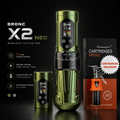
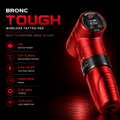
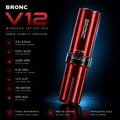
A wireless tattoo machine runs on a rechargeable battery built into or attached to the machine. A corded machine connects to an external power supply via a cable. Both deliver regulated power to the motor — the difference is how that power is sourced and what that means for how the artist works.
How Does Each System Work?
Wireless A rechargeable battery — either internal or clip-on — powers the motor directly. The machine communicates voltage settings via onboard controls and display. No cable runs between the machine and a power source.
Corded A power supply unit (PSU) converts mains electricity into regulated DC voltage. A cable — either RCA or clip cord — carries that voltage from the PSU to the machine. The artist adjusts voltage on the PSU rather than the machine.
What Are the Key Differences?
| Feature | Wireless | Corded |
|---|---|---|
| Power source | Internal/clip-on battery | External power supply |
| Freedom of movement | Full — no cable | Limited by cable length |
| Runtime | Battery dependent (4–15hrs) | Unlimited |
| Setup | Machine only | Machine + PSU + cable |
| Voltage control | Onboard — on the machine | On the power supply |
| Station clutter | Minimal | PSU, cable, footswitch |
| Weight | Heavier (includes battery) | Lighter machine body |
| Maintenance | Battery care required | PSU and cable care |
| Cost | Higher upfront | Lower machine cost, PSU additional |
What Are the Advantages of a Wireless Machine?
Freedom of movement No cable means the artist can move freely around the client without managing cord positioning. Repositioning for difficult angles, working around a table, or moving between stations requires no adjustment to a cable setup.
Cleaner station Without a power supply unit, cable, and footswitch, the workstation is significantly less cluttered. Fewer items on the tray means easier cleaning and a more professional client-facing setup.
Simpler operation Voltage, battery level, presets, and stroke settings are all visible on the machine's onboard display. The artist reads and adjusts settings without looking away from the work area.
Portability Wireless machines work anywhere — guest spots, conventions, home studios, and outdoor events — without needing access to a specific power supply unit.
What Are the Limitations of a Wireless Machine?
- Battery runtime — Sessions longer than the battery's tested runtime require either a mid-session charge or a battery swap
- Battery management — Tracking charge level, charging between sessions, and managing battery health adds an operational step corded machines don't require
- Weight — Including a battery adds weight to the machine body. Wireless machines typically weigh more than equivalent corded machines
- Battery degradation — Rechargeable batteries lose capacity over charge cycles. A battery that delivers 8 hours when new may deliver 6 hours after two years of professional use
What Are the Advantages of a Corded Machine?
Unlimited runtime As long as the power supply is connected, the machine runs. No battery management, no charge tracking, no mid-session swaps. For very long sessions or back-to-back bookings, corded operation removes one variable entirely.
Consistent power A quality PSU delivers exactly regulated voltage independent of battery charge state. Some wireless machines show minor power variation as the battery depletes — corded machines do not have this variable.
Lighter machine body Without a battery, the machine body itself is significantly lighter. Corded machines like the FK Irons Spektra Edge X weigh under 100g — impossible to achieve with a built-in battery.
Lower entry cost Corded machines are often priced lower than equivalent wireless machines. A PSU is an additional cost, but a quality PSU works with multiple machines across its lifespan.
What Are the Limitations of a Corded Machine?
- Cable management — The cord between machine and PSU needs to be managed during every session. Positioning, draping, and moving the cable adds a constant background task
- Fixed working radius — The artist can only move as far as the cable allows. Repositioning for difficult angles may require moving the PSU or using a longer cable
- Station complexity — PSU, cable, footswitch, and machine all need setup, placement, and maintenance
- Convention and travel use — Working outside a fixed studio requires bringing a PSU and managing cable setup in unfamiliar environments
Which Do Professional Artists Actually Use?
The professional studio market has shifted significantly toward wireless machines over the past five years.
Reasons for the shift:
- Battery technology has improved — modern wireless machines deliver 7–10 hours of professional runtime
- Onboard display and control systems have matured — voltage precision on wireless machines now matches or exceeds PSU control
- Station cleanliness has become a professional standard — clients expect minimal clutter and maximum hygiene
- Convention and guest spot work has increased — portability is a practical daily requirement for many working artists
Corded machines remain common for:
- Artists who trained on corded setups and prefer the familiar workflow
- Specialist lining machines where ultralight weight is the priority
- High-volume studios where unlimited runtime removes all battery management
Can I Use Both?
Yes — and many professional artists do.
A common professional setup:
- Primary machine: Wireless — handles the majority of daily work across all techniques
- Secondary machine: Corded specialist — a lightweight lining pen or a dedicated color machine for specific applications
This approach combines wireless freedom for most sessions with the specific advantages of corded operation where they matter most.
What Are the Most Common Mistakes When Choosing Between Wireless and Corded?
- Choosing wireless without planning for battery management — A wireless machine requires charging discipline. Running a session on a partially depleted battery affects motor consistency.
- Dismissing wireless due to old battery technology — Early wireless machines had short runtimes and inconsistent power. Modern professional wireless machines have largely closed the gap with corded performance.
- Assuming lighter is always better — A corded machine's lighter body is only relevant if cable management doesn't offset the ergonomic benefit.
- Not checking runtime claims against real working conditions — Manufacturer runtime figures are often measured at minimum voltage. Real-world runtime at professional working voltages is typically lower.
- Buying corded to save money without factoring in PSU cost — A corded machine requires a quality PSU to perform correctly. Budget PSUs produce inconsistent voltage that affects machine performance.
Best For
Wireless
- Studio artists working across multiple techniques daily
- Artists doing guest spots, conventions, or travel work
- Artists who prioritize station cleanliness and minimal setup
- SMP practitioners working in clinical environments
Corded
- Artists who work in a fixed studio position
- Specialist liner artists where ultralight machine weight is the priority
- High-volume studios doing very long sessions
- Artists who prefer unlimited runtime without battery management
Frequently Asked Questions
Is wireless power as consistent as corded?
Modern wireless machines from professional manufacturers deliver power that is consistent enough for professional studio work. The gap between wireless and corded power consistency has narrowed significantly. Some very sensitive fine line artists still prefer corded for maximum precision, but most professional techniques are well-served by current wireless technology.
How do I know when to charge a wireless machine?
Most wireless machines display battery percentage on an onboard screen. Professional practice is to charge fully between sessions rather than topping up partially — this maintains battery health and ensures you start every session at full capacity.
Can wireless machines be used as corded machines?
Some wireless machines include an RCA port that allows corded operation as an alternative to battery power. This gives artists the option to run wired when near a power source and wireless when away from one. Not all wireless machines include this feature.
What voltage does a PSU need to run a professional tattoo machine?
Most professional tattoo machines operate between 4.0V and 12.0V. A PSU should cover at least this range with stable, regulated output. PSUs with 0.1V increment adjustment give the same voltage precision as onboard wireless controls.
Do wireless machines work at conventions?
Yes — this is one of their primary advantages. Wireless machines require no mains power connection at the machine itself, making convention setups significantly simpler. A charged battery and a portable charger cover a full convention day for most professional machines.
Summary
Wireless machines offer freedom of movement, cleaner station setup, and portable operation at the cost of battery management and added weight. Corded machines offer unlimited runtime and lighter machine bodies at the cost of cable management and fixed working radius. The professional studio market has moved predominantly to wireless for daily use, with corded machines retained for specialist applications. Many working artists run both — wireless as their primary machine and a corded specialist for specific techniques.
Continue Learning
- What Is Torque in a Tattoo Machine and Why Does It Matter?
- How to Read a Tattoo Machine Spec Sheet — A Pro's Guide
- How to Choose Between Rotary and Coil for Studio Work
Recommended for Artists